Hyperrealism vs Traditional Realism: Key Differences
Artists, collectors, and critics often use realism and hyperrealism interchangeably. They are not the same movement. The table below clarifies the primary distinctions.
| Aspect |
Hyperrealism |
Traditional Realism |
| Detail Level |
Photographic or beyond-photo precision |
Accurate but human-rendered |
| Surface Texture |
Pores, dust, moisture, micro-detail |
Smooth or broadly textured |
| Medium |
Oil, acrylic, airbrush, pencil |
Oil, tempera, watercolour |
| Time to Complete |
Weeks to months per piece |
Days to weeks |
| Primary Intent |
Perceptual deception and awe |
Accurate depiction of subject |
| Scale |
Often larger than life |
Life-size or smaller |
| Era of Origin |
Late 20th century onwards |
Renaissance to 19th century |
Traditional realism seeks truthful representation. Hyperrealism seeks perceptual disruption. The goal is not merely accuracy but the cognitive experience of uncertainty.
Hyperrealism Art: Style Types
Hyperrealism is not a single stylistic category. Several distinct sub-styles have developed within the broader genre. Each carries different intentions, materials, and visual outcomes.
1. Photorealist Hyperrealism
Rooted in the photorealism movement of the late 1960s and early 1970s, this style uses photographs as reference material but surpasses them in clarity. Paintings in this category often depict chrome surfaces, glass reflections, and complex light refraction with a precision that challenges any photographic reproduction.
Example: Richard Estes painted urban diner windows with layered reflections of streets, pedestrians, and sky simultaneously visible in the glass. No single photograph can capture all those layers at once. Estes constructed the scene from multiple sources.
2. Figurative Hyperrealism
This sub-style focuses on the human form with clinical, unsettling accuracy. Artists working in figurative hyperrealism often work at scales larger than life, which magnifies detail to an uncomfortable degree. Skin texture, veins, asymmetries in facial features, and the subtle sag of ageing tissue are rendered without idealisation.
Example: Ron Mueck's sculpture Dead Dad (1996-97) depicted a shrunken, pale, naked figure of his deceased father at roughly one-third life size. The silicone surface, real hair, and precise anatomical rendering made audiences visibly uncomfortable. The work was exhibited at the Sensation exhibition in London in 1997.
3. Still Life Hyperrealism
Everyday objects such as food, fabric, plastic wrappers, glass bottles, and ceramic dishes are depicted with a level of surface detail that makes the ordinary appear monumental. The intention is frequently to destabilise the viewer's sense of scale and material.
Example: Dutch artist Tjalf Sparnaay paints fried eggs, hamburgers, and chocolate bars at canvas sizes that reach one and a half metres wide. The paint surface mimics the exact translucency of egg white and the precise matte quality of a burger bun.
4. Sculptural Hyperrealism
Sculptural hyperrealism is arguably the most perceptually confrontational form. Three-dimensional figures constructed from silicone, polyester resin, fiberglass, glass eyes, and real or synthetic hair are displayed in gallery settings without pedestals, as though they have simply walked into the room.
Example: Australian sculptor Sam Jinks works at true life scale. His figures show wrinkled elderly skin, visible capillaries, and weighted body postures that suggest breath. Viewers regularly mistake them for living people before approaching closely
Characteristics of Hyperrealism Art
Regardless of style type or medium, hyper realistic works share a consistent set of defining characteristics.
1. Photographic or Supra-Photographic Detail
Every visible surface is resolved to a level of detail that matches or exceeds what a macro camera lens would capture. Skin cells, textile fibres, dust motes, and moisture are all present.
2. Deliberate Absence of Visible Brushwork
In painting, one of the defining technical achievements of hyperrealism is the complete suppression of the artist's hand. There are no visible brushstrokes, palette knife marks, or surface texture from paint application. The surface appears smooth and printed.
3. Controlled Light and Shadow
Hyperrealist artists study light sources with scientific precision. Ambient occlusion, specular highlights, subsurface scattering in skin, and refracted colour in translucent surfaces are all rendered with accuracy that most painters never attempt.
4. Psychological or Emotional Resonance
Contrary to the assumption that hyperrealism is purely technical, most significant works in the genre carry emotional or conceptual weight. The subject matter is deliberately chosen to evoke recognition, discomfort, nostalgia, or mortality.
5. Scale as a Device
Many hyperrealist painters and sculptors work at scales significantly larger or smaller than life. Oversized still life objects and undersized human figures both create a perceptual displacement that pure representation at normal scale would not produce.
6. Multiple Reference Sources
Unlike traditional realism, which may work from a single life model or observed scene, hyperrealist artists typically construct their compositions from multiple photographic references, combining lighting, perspective, and detail from different sources into a unified image.
Techniques Used in Hyperrealistic Painting
Hyperrealism demands exceptional technical control. Below are the core techniques that define the discipline.
Layering and Glazing
Oil paint is applied in successive transparent glazes, each allowed to dry before the next is added. This builds optical depth that mimics how light behaves inside skin, fabric, or glass. A hyperrealist portrait of a face may involve thirty or more transparent layers.
Airbrush Application
Many hyperrealist painters use an airbrush for areas requiring seamless tonal gradation, such as skies, chrome surfaces, and skin. The airbrush eliminates the physical mark of the brush and allows smooth transitions across large areas.
Grid Transfer Method
Reference photographs are divided into a precise grid. The canvas is divided into a corresponding grid at the intended scale. Each grid square is painted independently, maintaining proportional accuracy across the entire composition.
Trompe l'Oeil Integration
Some hyperrealist works incorporate trompe l'oeil elements, where painted objects appear to project off the canvas surface. Painted shadows, fly-away threads, and cracked paint effects exploit the viewer's spatial perception.
Material Matching in Sculpture
Sculptural hyperrealism requires material science as much as artistic skill. Silicone is tinted and layered in depths that mimic the translucent quality of human skin. Glass eyes are custom-made to match the reflectivity of living tissue. Hair is individually inserted using surgical needles.
Notable Hyperrealistic Artworks
Supermarket Shopper (1970) — Duane Hanson

A life-size polyester figure of a middle-aged woman pushing a supermarket trolley. Placed in gallery settings without a plinth, the figure was initially mistaken for a museum visitor by countless viewers. Hanson's work established the sculptural hyperrealism tradition in America.
A Girl (2006) — Ron Mueck
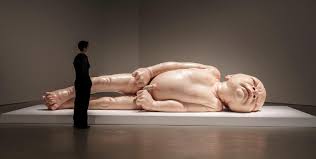
A five-metre long figure of a newborn infant. The enormous scale combined with precise biological accuracy produces a response of awe and unease simultaneously. Currently in the collection of the National Gallery of Canada.
The Hamburger (2009) — Tjalf Sparnaay
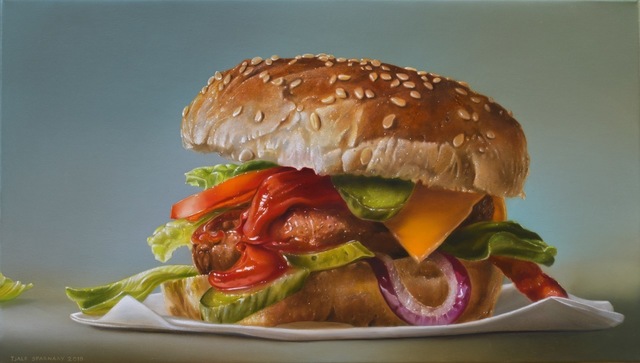
An oil on canvas painting measuring 100 cm by 100 cm depicting a single hamburger with photographic precision at over-scale. The surface detail of the bun texture, the translucency of the melted cheese, and the compression of the meat patty are rendered with a technical control that places it among the canonical still life hyperrealist works.
Self Portrait in Pencil (2013) — Diego Fazio

A coloured pencil self-portrait that sparked extensive international debate about whether it was a photograph or a drawing. The work demonstrated that pencil could achieve surface resolution comparable to photographic reproduction and brought significant public attention to the hyperrealist pencil tradition.
Hyperrealism in the Indian Art Context
Hyperrealism as a formal genre has a smaller but growing presence in Indian contemporary art. Several Indian artists have adopted photorealistic and hyperrealistic techniques within figurative painting, particularly in portraiture and urban scene depiction.
The Indian art market has shown increasing appetite for technically demanding figurative work. Collectors acquiring hyperrealist work internationally have begun directing attention toward Indian practitioners who combine Western photorealist technique with distinctly Indian subject matter including street scenes, textile surfaces, and agricultural landscapes rendered at extreme detail levels.
As with global hyperrealism, the strongest Indian works in this tradition carry emotional and social content beyond technical demonstration. The precision of the surface serves the narrative rather than existing for its own sake.


